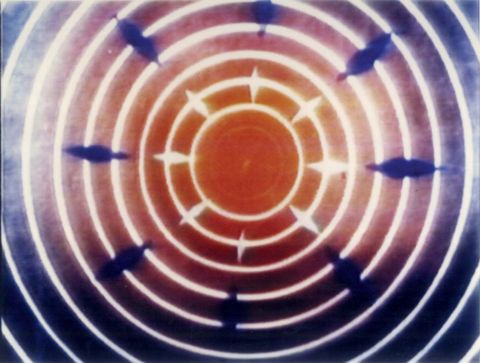
Allegretto, Oskar Fischinger, United States. Choice of Robin Noorda
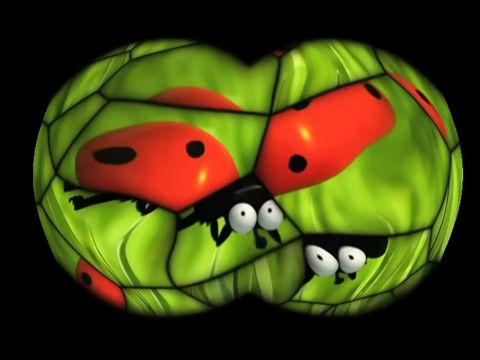
Minuscule: Lady Bug, Thomas Szabo, France. Choice of Robin Noorda
As an eight-year old, I spent my holidays in the south of England looking for fossils with my family. I had already gathered some museum-worthy samples when in the famous seaside town of Lyme Ridges Disney’s Fantasia was screened in a small theatre. Of course, the evolution scene in particular deeply impressed me. But despite this preoccupation with prehistory, it was Oskar Fischinger’s abstract music rendition that overwhelmed me. From then on, the choreography in the image-sound relationship played a decisive role in my life. When I was an adolescent and saw Paul Driessen’s The Killing of an Egg, I knew I wanted to tell stories with image and sound, too. At the Rietveld Academy, I studied AV and animation, but I was especially disappointed in the degree in which the A of audio was represented: we only had a broken microphone. The CEM (Contactorgaan Elektronische Muziek) changed this. I went on to make an audio-visual for which the audio composition was generated by synthesizers and colour sensors from the colours of abstract macro-images under polarised light. This produced an entirely atonal cacophony, but with a tangible sense of synchronicity. As a student, I learned to appreciate the use of real synchronicity, admitting coincidence into the image-sound relationship, after putting an arbitrary piece of music under already edited images and noticing that it seemed to be made to measure. For our film Red-end, we were lucky that the process of the developing score ran parallel to the shoot. This resulted in a highly coherent image-sound relationship. But specific and figurative sound for film is still another passion of mine. The narrative and evocative power of sound is a particularly underrated phenomenon. The unavoidable sound is so much more powerful than the image. The French series Minuscule is one such lovely example in which sound is an elementary idiom and often is more telling than the image.
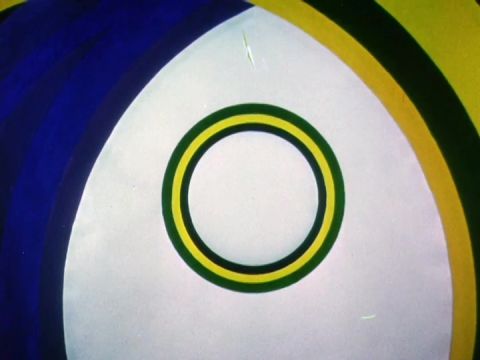
Kreise (Circles), Oskar Fischinger, Germany. Choice of Dominic Buttimore
I came across Oskar Fischinger’s work whilst studying abstract artist Kandinsky, of whom Oskar was a great fan. He was an abstract purist, removing his name from the credits of the sequence that he did for Disney’s Fantasia because his work had been redrawn in too figurative a style! I love Fischinger’s work for its diversity and experimentalism – he is an artist who chooses to work in animation. Circles was made whilst he was living in Hitler’s Germany and was in fact a commercial. He had originally conceived of the work as an abstract film but he would have fell foul of the Nazi censor for creating ‘degenerate’ art. So instead he created the piece as an ad which was not censored in the same way. I think the idea of his commercial being an outlet for abstract art animation is great and inspires me to think that we can create art through advertising, which is what we try to do.
UBU, Geoff Dunbar, United Kingdom. Choice of Dominic Buttimore
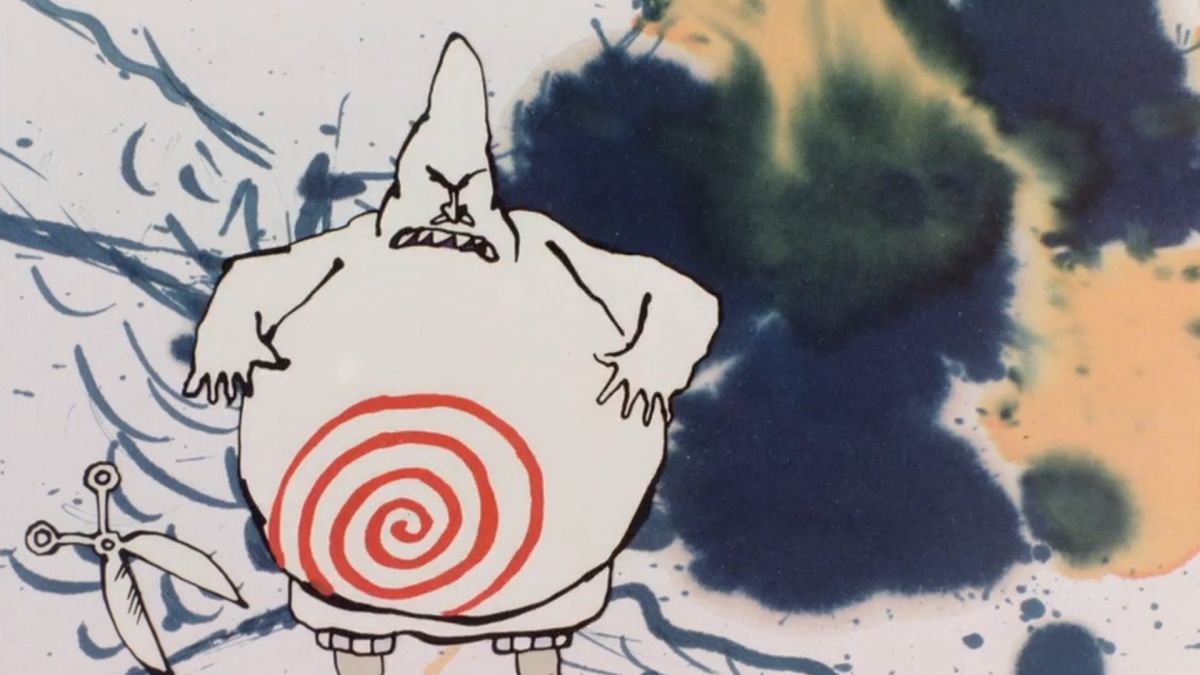
This is the first animated film that I saw that wasn’t Disney. I saw it at our school film club and it was the only animated film that was shown that year. It changed my view of animation from being just talking animals, songs and slapstick to an understanding of the wider possibilities of the medium. Don’t get me wrong, Jungle Book is a favourite of mine, but this film Ubu brought a new dimension of character animation to me – cool looking, rude and irreverent. Geoff Dunbar’s realisation of Alfred Jarry’s 17th century play (Ubu Roi) in animation also brought a theatrical piece to me which I didn’t know and later read and enjoyed. Animated burps and farts – great.
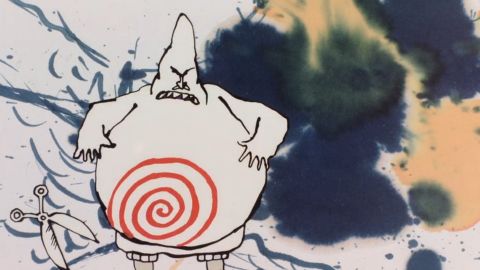
Ink splashes, smudges, guttural sounds and lewd violence: an arsenal entirely fit for adapting Alfred Jarry’s late 19th century theatrical fusillade.
Kaboom Animation Festival is de one-stop-shop voor het nieuwste en beste op het gebied van animatie. Van vernieuwende experimentele arthouse tot kleurrijke verhalen voor families en kinderen: Kaboom voorziet in ieders animatiebehoefte. Ja, zelfs in die van jou, mijn geweldige rare vriend!
© 2026. Website door Have a Byte!